


Worms remain one of the most controversial topics in medicine.Some doctors still believe that nighttime teeth grinding and indigestion are the first symptoms of worms in humans.
Other experts believe that worm infections are not dangerous and recommend that no action be taken if parasites are found.
Types of human worms
There are more than 300 kinds of parasites known in medicine that can live in the human body.Helminths are worms of the genus Helminth that live in the bodies of mammals (humans and animals).It may cause no apparent harm to the host's body.But in some cases, it can lead to the development of serious conditions.
What do worms look like?It depends on the type of worm, there are two types in humans:
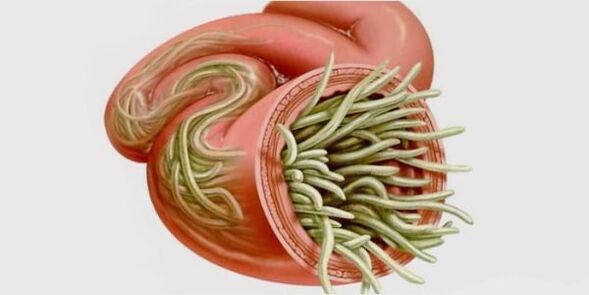
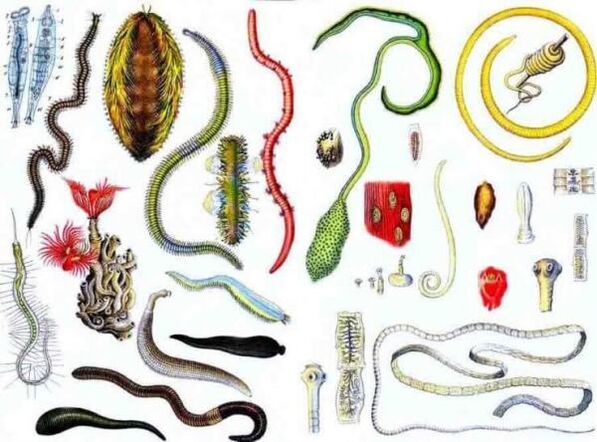
- round.These are roundworms, pinworms, and whipworms.Large roundworms, which can reach 10-40 cm in length, often accumulate in the small intestine and block it.Pinworms are small roundworms that are no longer than 1 cm in length.Whipworms live in the large intestine and can reach 4-5 cm in length.The eggs look different, but are almost always round.
- tape.These worms include tapeworms and tapeworms.They are characterized by a long body (up to several meters) and a small head.Elongated and flat worms in humans can colonize the intestines, liver and other organs.This subspecies includes flukes with flat, long bodies and heads.They also have suction grooves or suction cups.
In addition to these species, the body is also colonized by giardia and protozoa, affecting the liver and small intestine.All types of parasites are characterized by their inability to exist completely outside the host's body, their high reproductive capacity, and their ability to spread throughout the body.
Where do they live?
To understand why worms are harmful, you need to understand their types and their location in the body.When the worms are initially located in the intestines, they can easily travel through the bloodstream to the lungs, liver, brain, and visual organs.
Most commonly, worms inhabit the intestines.They damage mucous membranes as the parasites suck or gnaw at the lining of the intestines in order to obtain food.
To obtain nutrients, they constantly require digested food or blood.The more parasites there are in the gut, the more nutrients are taken from the host.Toxin poisoning occurs.The waste products of the worms enter the intestinal lumen and then enter the human bloodstream, causing systemic poisoning.
Classification
Depending on the parasite's habitat in nature, worms in humans can be divided into the following types:
- soil worm.Part of the life cycle occurs in the soil.Usually, the parasite eggs fall into the ground in feces and enter the body of the new host along with soil, vegetables and fruits.Ground worms include roundworms, whipworms, hookworms, and hookworms.
- biological worm.In order for these parasites to grow and mature, they must remain permanently inside the mammal's body.The eggs begin to develop when they enter the body of an intermediate host (animal, bird or fish).In order to mature and reproduce, worms must enter a new organism, usually a warm-blooded animal or a human.These worms include tapeworms, nematodes, and echinococci.
- exposure to worms.The smallest group.Infection with these worms occurs through direct contact with the owner or their personal belongings and clothing.Infectious parasites include pinworms and dwarf tapeworms.
Why are worms harmful?
Doctors often debate whether and how dangerous worms are.There is a belief that no parasite can survive in a healthy human body.If they stayed, they would be in very limited numbers and not do much harm.
This theory is confirmed by its proponents because a person encounters many disease-causing bacteria, viruses, and other microorganisms every day, and the body is able to successfully deal with these microorganisms.
Due to natural defense mechanisms, a person can overcome worms that enter the gastrointestinal tract or on the skin.But if the infection load is high and the parasite finds itself in an environment favorable to itself, worms in the intestines or liver can lead to the development of many diseases.
The extent of damage to the body depends on how long the worms survive in the body.The parasite's residence time depends on its type.If a person is an intermediate host, some of them will leave the body after a reproductive cycle, such as when infected with a bovine tapeworm or a cat fluke.But in most cases, parasites remain in the body for many years.
The consequences of worm infection are a weakened immune system, impaired digestion, and a general physical weakness that is unable to cope with normal stress and other illnesses.Worm infections are especially dangerous for children and women.Parasites can interfere with a child's overall growth and development and, in pregnant women, can cause miscarriage or fetal growth retardation.
Symptoms of worms
With parasitic infections, there are manifestations common to all types of infection as well as characteristics specific to each species.
Common symptoms of worms in adults:
- Body temperature rises to low fever for no apparent reason;
- Abdominal pain, right ribs;
- Unstable stool;
- changes in appetite;
- lose weight;
- Weakness, worsening of performance, headache.
The following symptoms are characteristic of ascariasis:
- Nausea, abdominal and right rib pain;
- Skin rash that appears periodically throughout the body;
- Decreased appetite and weight loss.
With pinworms (pinworms), the following are observed:
- stomach ache;
- Itching in the anal area;
- Changes in appetite.
Diphyllobothriasis (human tapeworm) manifests as follows:
- Nausea, vomiting;
- abdominal pain;
- indigestion;
- Weakness, headache, fainting.
If the worms get into the liver, lungs, or other internal organs, no symptoms of infection may be observed for a long time.Then signs of specific organ dysfunction appear: cough, jaundice of the skin, tachycardia.
Which doctor should I contact for a worm infection?
If you suspect you have worms in your stomach, you can contact your pediatrician or therapist, who will refer you for testing and prescribe treatment.Additionally, worms in the stomach require consultation with an infectious disease specialist or parasitologist.
diagnosis
Detection of worms can be done in a variety of ways:
- Stool analysis and egg scraping.Most worms live in the intestines, so the parasite's eggs or body parts can be found in stool or scrapings.The disadvantage of this method is its low reliability, since parasites in feces can only be detected in cases of massive infection.
- ELISA to detect helminth infection.Enzyme immunoassay methods allow you to detect parasite antibodies.In acute infection, IgM is measured, if a person already has a parasitic disease, or if the infection has become chronic, IgG is measured.
- blood test.Detects antibodies to certain types of worms.It is considered the most accurate diagnostic method.
There are also less common diagnostic methods: using a thermal imager or the electromagnetic vibrations produced by the parasite to determine worm infection.However, these methods are not widely used.In order to confirm the diagnosis, abdominal ultrasound, cardiac ultrasound, visceral CT and vascular MRI are also required.
Treatment of helminth infection
The diagnosis of parasitic diseases often causes negative reactions in patients, which is why they even refuse treatment.So what should you do if parasites are found on someone in your family or on you?
Today, there are no difficulties in treating helminth infections in adults and children.There are a large number of drugs - broad spectrum or highly specialized - that target parasites.
Under no circumstances should you self-medicate, let alone attempt to rid an adult or child of parasites on your own.Each drug has its own level of toxicity that can cause intoxication in the body.Only a doctor can prescribe the appropriate medication and regimen.
drug treatment
In order to eliminate worms, it is recommended to take the following measures:
- Universal preparation for all types of parasites.
- These drugs are active against roundworms and hookworms.
- Broad spectrum drugs.
All types of worming medications can only help eliminate adult worms.Therefore, several courses of treatment are required to completely eliminate all larvae and eggs.
traditional method
To get rid of worms, there are the following recipes:
- Mugwort powder.Take 0.5 tsp.Once a day for 3 consecutive days.
- Green nut skin.Soak it in alcohol for 10-14 days and take 1 teaspoon.Once a day.
- Clove seeds.Place the chopped cloves on the tip of the knife.The course of treatment lasts 7-10 days.
diet
When treating worm infections, it is recommended not to eat heavy foods or to temporarily refuse to eat to enhance the therapeutic effect.To speed up the removal of toxins from your body, you need to drink as much fluid as possible.
Infection routes and prevention
There are three main ways to become infected with helminths:
- food.The most common route of infection.Eggs can be carried in water or soil; they are easily infected by eating unwashed fruits, vegetables and berries.Large numbers of parasites live in unheated river fish and seafood, raw meat and dairy products.
- Failure to follow personal hygiene rules.You can get worms anywhere: public dining venues, transport, shops, streets, through contact with street animals and domestic animals.The only methods of prevention remain personal hygiene and monitoring your pet's condition.
- Contact information and family.This is how worm infection spreads among children.It is also possible to infect members of the same household by sharing towels, bedding or clothing.
Can worms spread directly from person to person?This is rare, but being in close contact with an infected person increases the risk of infecting others several times.The only way to prevent helminthiasis is to observe personal hygiene rules and process food carefully.
Annual testing and check-ups with your doctor are recommended.If worms are not treated, a person's health can be seriously affected.With the invasion of certain types of parasites, there are life-threatening dangers.